Showing posts with label Tokoh. Show all posts

Jules Verne


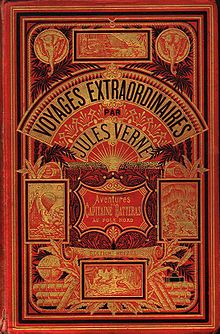
This is google looks like when its 8 Feb 2011. Google celebrate Jules Verne. Jules Gabriel Verne (French pronunciation: [ʒyl vɛʁn]; February 8, 1828 – March 24, 1905) was a French author from Brittany who pioneered the science-fiction genre. He is best known for novels such as Twenty Thousand Leagues Under the Sea (1870), A Journey to the Center of the Earth (1864), and Around the World in Eighty Days (1873). Verne wrote about space, air, and underwater travel before air travel and practical submarines were invented, and before practical means of space travel had been devised. He is the third most translated individual author in the world, according to Index Translationum. Some of his books have also been made into films. Verne, along with Hugo Gernsback and H. G. Wells, is often popularly referred to as the "Father of Science Fiction".

Hetzel substantially influenced the writings of Verne, who was so happy to finally find a willing publisher that he agreed to almost all changes that Hetzel suggested. Hetzel rejected at least one novel, (Paris in the 20th Century), and asked Verne to significantly change his other drafts. One of the most important changes Hetzel enforced on Verne was the adoption of optimism in his novels. Verne was in fact not an enthusiast of technological and human progress, as can be seen in his works created before he met Hetzel and after Hetzel's death. Hetzel's demand for optimistic texts proved correct. For example, Mysterious Island originally ended with the survivors returning to mainland forever nostalgic about the island. Hetzel decided that the heroes should live happily, so in the revised draft, they use their fortunes to build a replica of the island. Many translations are like this. Also, in order not to offend France's then-ally, Russia, the origin and past of the famous Captain Nemo were changed from those of a Polish refugee avenging the partitions of Poland and the death of his family in the January Uprising repressions to those of an Indian prince fighting the British Empire after the Sikh War.

He wrote many books such as

* Five Weeks in a Balloon (Cinq Semaines en ballon, 1863)

* Paris in the 20th Century (Paris au XXe Siecle, 1863, not published until 1994)

* Journey to the Center of the Earth (Voyage au centre de la Terre, 1864)

* From the Earth to the Moon (De la terre à la lune, 1865)

* Journeys and Adventures of Captain Hatteras (Voyages et aventures du capitaine Hatteras, 1866)

* In Search of the Castaways or Captain Grant's Children (Les Enfants du capitaine Grant, 1867–1868)

* Twenty Thousand Leagues Under the Sea (Vingt mille lieues sous les mers, 1870)

* Around The Moon (Autour de la lune, a sequel to From the Earth to the Moon, 1870)

* A Floating City (Une ville flottante, 1871)

* Dr. Ox's Experiment (Une Fantaisie du Docteur Ox, 1872)

* The Adventures of Three Englishmen and Three Russians in South Africa (Aventures de trois Russes et de trois Anglais, 1872 )

* The Fur Country (Le Pays des fourrures, 1873)

* Around the World in Eighty Days (Le Tour du Monde en quatre-vingts jours, 1873)

* The Survivors of the Chancellor (Le Chancellor, 1875)

* The Mysterious Island (L'Île mystérieuse, 1875)

* The Blockade Runners, (1876)

* Michael Strogoff (Michel Strogoff, 1876)

* Off On A Comet (Hector Servadac, 1877)

* The Child of the Cavern, also known as Black Diamonds or The Black Indies (Les Indes noires, 1877)

* Dick Sand, A Captain at Fifteen (Un Capitaine de quinze ans, 1878)

* The Begum's Millions (Les Cinq cents millions de la Bégum, 1879)

* The Steam House (La Maison à vapeur, 1879)

* Tribulations of a Chinaman in China (Les tribulations d'un chinois en Chine), 1879

* Eight Hundred Leagues on the Amazon (La Jangada, 1881)

* The Green Ray (Le Rayon vert, 1882)

* The Headstrong Turk (1883)

* Frritt-Flacc (1884)

* The Vanished Diamond (L’Étoile du sud, 1884)

* The Archipelago on Fire (L’Archipel en feu, 1884)

* Mathias Sandorf (1885)

* Robur the Conqueror or The Clipper of the Clouds (Robur-le-Conquérant, 1886)

* Ticket No. "9672" (Un Billet de loterie, 1886 )

* North Against South (Nord contre Sud, 1887)

* The Flight to France (Le Chemin de France, 1887)

* Family Without a Name (Famille-sans-nom, 1888)

* Two Years' Vacation (Deux Ans de vacances, 1888)

* The Purchase of the North Pole (Sans dessus dessous, the second sequel to From the Earth to the Moon, 1889)

* Mistress Branican (Novel) (1891)

* The Castle of the Carpathians (Le Château des Carpathes, 1892)

* Propeller Island (L’Île à hélice, 1895)

* Facing the Flag (Face au drapeau, 1896)

* Clovis Dardentor (1896)

* The Sphinx of the Ice Fields or An Antarctic Mystery (Le Sphinx des glaces, a sequel to Edgar Allan Poe's The Narrative of Arthur Gordon Pym, 1897)

* The Mighty Orinoco (Le Superbe Orénoque, 1897)

* The Village in the Treetops (Le Village aérien, 1901)

* Master of the World (Maître du monde, sequel to Robur the Conqueror, 1904)

* Invasion of the Sea (L’Invasion de la mer, 1904)

* A drama in Livonia (Un Drame en Livonie, 1904)

* The Lighthouse at the End of the World (Le Phare du bout du monde, 1905)

* The Chase of the Golden Meteor (La Chasse au météore, 1908)

* The Danube Pilot (Le Pilote du Danube, 1908)

* The Survivors of the 'Jonathan' (Les Naufragés du « Jonathan », 1909)

posted under | 0 Comments

Youtube Inventor


YouTube adalah sebuah situs web video sharing (berbagi video) populer yang didirikan pada Februari 2005 oleh tiga orang bekas karyawan PayPal: Chad Hurley, Steve Chen, dan Jawed Karim. Menurut perusahaan penelitian Internet Hitwise, pada Mei 2006 YouTube memiliki pangsa pasar sebesar 43 persen. Para pengguna dapat memuat, menonton, dan berbagi klip video secara gratis. Umumnya video-video di YouTube adalah klip musik (video klip), film, TV, serta video buatan para penggunanya sendiri. Format yang digunakan video-video di YouTube adalah .flv yang dapat diputar di penjelajah web yang memiliki plugin Flash Player.

Pada 9 Oktober 2006 diumumkan bahwa YouTube telah dibeli Google dengan harga US$1,65 miliar.Pada awal April 2008 beberapa ISP Indonesia menutup akses ke beberapa situs web termasuk YouTube karena memuat film Fitna. Awalnya pemblokiran berupa pemblokiran sepenuhnya terhadap seluruh situs web, namun kemudian diubah menjadi pemblokiran terhadap URL tertentu yang memuat video tersebut saja


History

YouTube was founded by Chad Hurley, Steve Chen, and Jawed Karim, who were all early employees of PayPal. Hurley had studied design at Indiana University of Pennsylvania, while Chen and Karim studied computer science together at the University of Illinois at Urbana-Champaign.

According to a story that has often been repeated in the media, Hurley and Chen developed the idea for YouTube during the early months of 2005, after they had experienced difficulty sharing videos that had been shot at a dinner party at Chen's apartment in San Francisco. Karim did not attend the party and denied that it had occurred, while Hurley commented that the idea that YouTube was founded after a dinner party "was probably very strengthened by marketing ideas around creating a story that was very digestible."

YouTube began as a venture-funded technology startup, primarily from a US$11.5 million investment by Sequoia Capital between November 2005 and April 2006 YouTube's early headquarters were situated above a pizzeria and Japanese restaurant in San Mateo, CaliforniaThe domain name www.youtube.com was activated on February 14, 2005, and the website was developed over the subsequent months.

The first YouTube video was entitled Me at the zoo, and shows founder Karim at the San Diego Zoo. The video was uploaded on April 23, 2005, and can still be viewed on the site


posted under , | 0 Comments

Alexander Flemming

Sir Alexander Fleming (6 August, 1881 – 11 March, 1955) was a Scottish biologist and pharmacologist. He wrote many articles on bacteriology, immunology, and chemotherapy. His best-known discoveries are the discovery of the enzyme lysozyme in 1923 and the antibiotic substance penicillin from the mold Penicillium notatum in 1928, for which he shared the Nobel Prize in Physiology or Medicine in 1945 with Howard Florey and Ernst Chain.


Early life

Fleming was born on August 6, 1881 at Lochfield, a farm near Darvel in Ayrshire, Scotland. He was the third of the four children of Hugh Fleming (1816–1888) from his second marriage to Grace Stirling Morton (1848–1928), the daughter of a neighbouring farmer. Hugh Fleming had four surviving children from his first marriage. He was 59 at the time of his second marriage, and died when Alexander (known as Alec) was seven.

Fleming went to Loudoun Moor School and Darvel School, and though the two before were modest schools at best, earned a two-year scholarship to Kilmarnock Academy before moving to London where he attended the Royal Polytechnic Institution.[4] After working in a shipping office for four years, the twenty-year-old Fleming inherited some money from an uncle, John Fleming. His elder brother, Tom, was already a physician and suggested to his younger sibling that he follow the same career, and so in 1903, the younger Alexander enrolled at St Mary's Hospital, Paddington, London. He qualified for the school with distinction in 1906 and had the option of becoming a surgeon.

By chance, however, he had been a member of the rifle club (he had been an active member of the Volunteer Force since 1900). The captain of the club, wishing to retain Fleming in the team suggested that he join the research department at St Mary's, where he became assistant bacteriologist to Sir Almroth Wright, a pioneer in vaccine therapy and immunology. He gained an M.B. and then a B.Sc. with Gold Medal in 1908, and became a lecturer at St. Mary's until 1914. On 23 December 1915, Fleming married a trained nurse, Sarah Marion McElroy of Killala, County Mayo, Ireland.

Fleming served throughout World War I as a captain in the Royal Army Medical Corps, and was Mentioned in Dispatches. He and many of his colleagues worked in battlefield hospitals at the Western Front in France. In 1918 he returned to St. Mary's Hospital, which was a teaching hospital. He was elected Professor of Bacteriology in 1928.


In 1955, Fleming died at his home in London of a heart attack. He was cremated and his ashes interred in St Paul's Cathedral a week later.


Honours, awards and achievements

His discovery of penicillin had changed the world of modern medicine by introducing the age of useful antibiotics; penicillin has saved, and is still saving, millions of people around the world.

The laboratory at St Mary's Hospital, London where Fleming discovered penicillin is home to the Fleming Museum. There is also a school in the city Lomita in Los Angeles County, California named Alexander Fleming Middle School. The University of Westminster has named one of its student buildings located near Old Street in honour of Fleming and Imperial College also has a building named after him, the Sir Alexander Fleming Building. It is based in the South Kensington campus and is the site of much of the preclinical undergraduate medical teaching.

* Fleming, Florey and Chain jointly received the Nobel Prize in Medicine in 1945. According to the rules of the Nobel committee a maximum of three people may share the prize. Fleming's Nobel Prize medal was acquired by the National Museums of Scotland in 1989, and will be on display when the Royal Museum re-opens in 2011.

* Fleming was awarded the Hunterian Professorship by the Royal College of Surgeons of England

* Fleming and Florey were knighted in 1944.

* Florey went on to be elected President of the Royal Society in 1943 and received the greater honour of a peerage in 1965 for his monumental work in making penicillin available to the public and saving millions of lives in World War II, becoming a Baron.

* When 2000 was approaching, at least three large Swedish magazines ranked penicillin as the most important discovery of the millennium. Some of these magazines estimated that about 200 million lives have been saved by this discovery.[citation needed]

* A statue of Alexander Fleming stands outside the main bullring in Madrid, Plaza de Toros de Las Ventas. It was erected by subscription from grateful matadors, as penicillin greatly reduced the number of deaths in the bullring.

* Flemingovo náměstí is a square named after Fleming in the university area of the Dejvice community in Prague.

* In mid-2009, Fleming was commemorated on a new series of banknotes issued by the Clydesdale Bank; his image appears on the new issue of £5 notes.


posted under , | 0 Comments
Older Posts Home
this is place for me to share my school task http://www.smileycodes.info

Translate my Page

Followers

note from owner

aku pasti ngusahain blog ini di update terus.. kendala pasti ada karna setiap hari (hampir) pulang jam 4 SORE.
Aku updatenya juga nano-nano. Kadang basing, kadang bindo. dont be surprised. hehe
so stick with me


Recent Comments